
Blog

Smart Routing Explained: How the Best Open Banking Platforms Actually Work
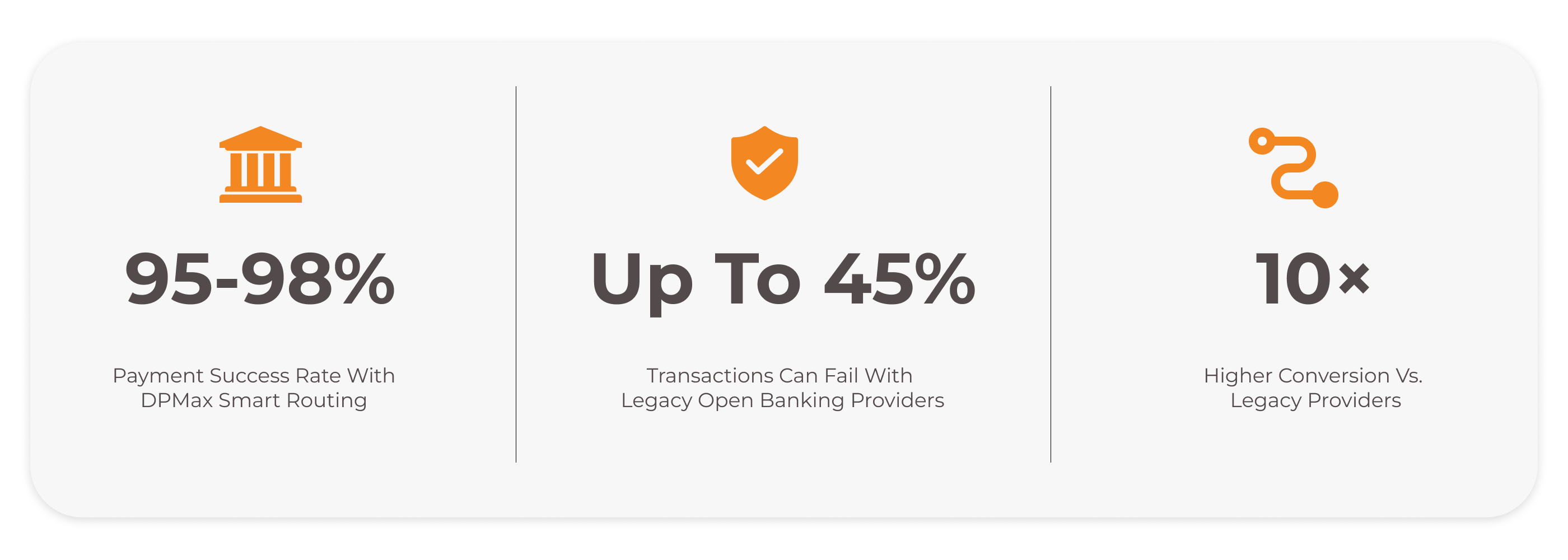
Most merchants don't know that up to 45% of their open banking transactions can fail at checkout. DPMax was built to change that - achieving 95-98% payment success rates through Europe's most advanced smart routing technology.
Open banking promised a revolution. A world where consumers could pay directly from their bank accounts, cutting out card networks and the margin-eroding fees that come with them. For merchants, the appeal was obvious: lower costs, faster settlement, and cleaner payment flows.
The reality has been more complicated. For many merchants, open banking has delivered fragmented coverage, unstable connections, and failure rates that would be unacceptable in any other payment channel. The gap between what open banking promises and what it routinely delivers is, at its root, a routing problem.
The platforms that have solved it - and the difference between a 55% and a 95% success rate can determine whether a business thrives or fails - are those that built intelligent routing as a core capability, not an afterthought. DPMax is Europe's leading example of exactly that.
The real open banking challenge merchants face
The promise of open banking is real. The infrastructure challenges are equally real. Before understanding what smart routing does, it's worth being honest about what merchants are actually up against.
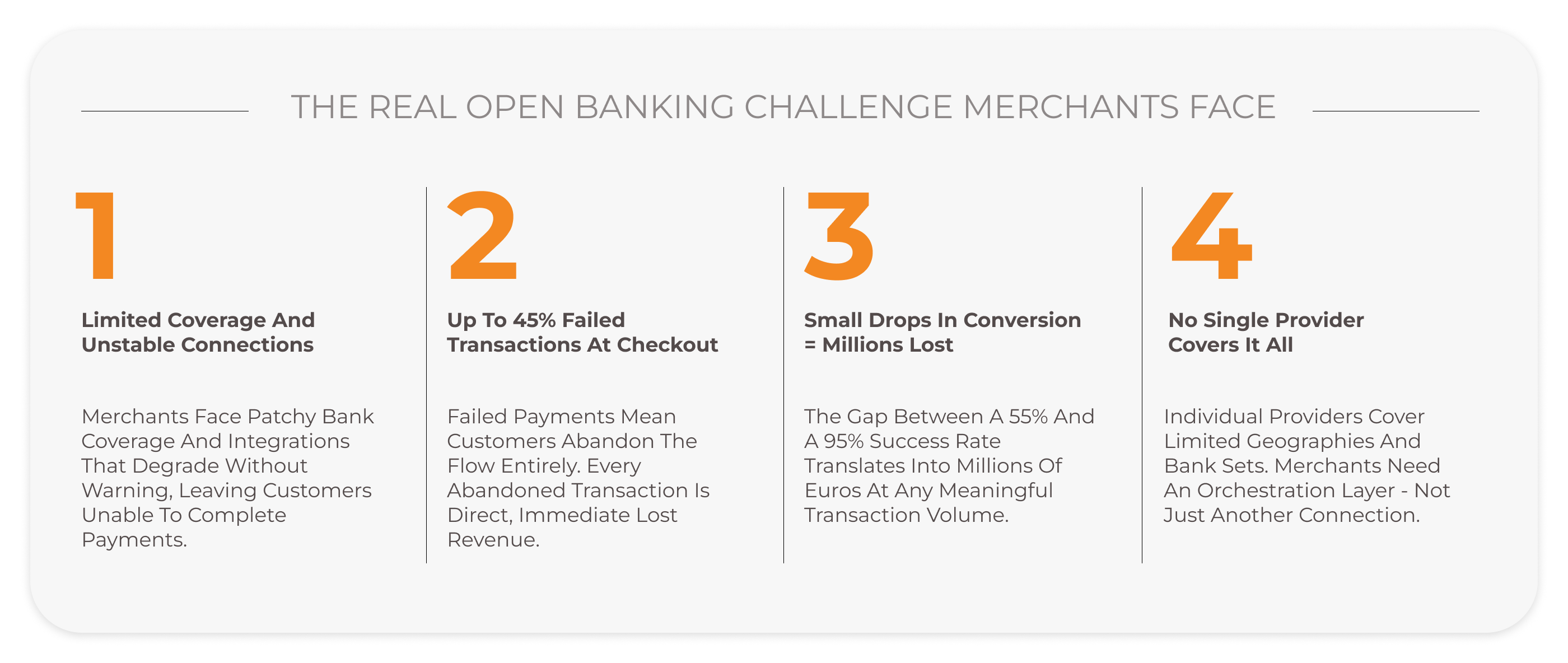
Individual providers cover limited geographies and bank sets. Merchants need an orchestration layer - not just another connection.
This is the context in which smart routing matters. It isn't a nice-to-have optimisation for platforms running at scale. It is the foundational capability that determines whether open banking actually works as a payment channel for merchants at all.
What smart routing actually does
Smart routing is a real-time decision engine sitting between a merchant's application and the underlying bank APIs. When a payment is initiated, the engine evaluates the available paths - across banks, aggregators, and payment rails - and selects the optimal route for that specific transaction, in that specific moment.
"Smart AI routing technology that chooses the most efficient path for each transaction - that's not a feature of DPMax. It's the engine the entire platform is built around."
DPMax goes further than simple routing logic. The platform unifies all banks and regions into a single orchestration layer, so the routing engine has the widest possible set of paths to choose from - and built-in redundancy to fall back on when any individual connection degrades.
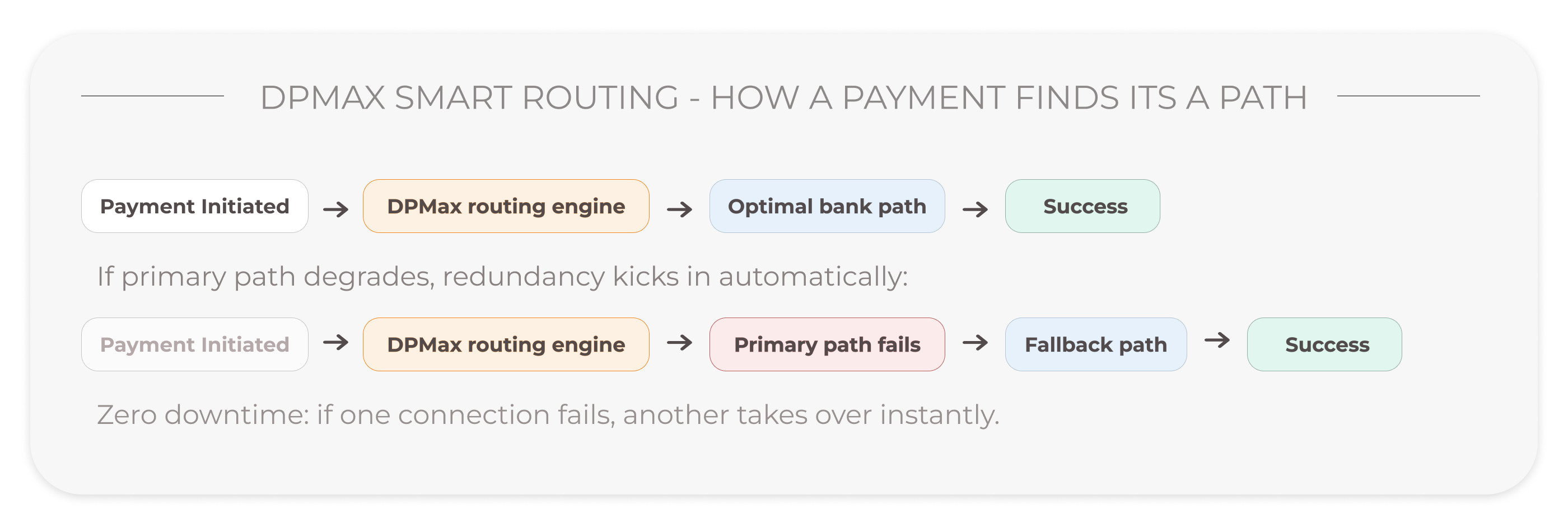
The key distinction between a smart routing platform and a basic open banking provider is that redundancy is architectural - built into the platform from the ground up, not bolted on. DPMax's redundancy means that if one connection fails, another takes over instantly, resulting in zero downtime for merchants.
What makes DPMax different
DPMax is more than a payment provider. It is a true orchestration platform that unifies all banks and regions into a single solution. Four pillars define what sets it apart from other open banking infrastructure:
Widest European bank coverage
DPMax covers banks across the full European market - not just EUR countries. Full support for SEK, DKK, NOK, GBP, CHF, PLN, HUF, and CZK means true pan-European reach from a single integration.
Smart AI routing
AI-driven technology that dynamically selects the most efficient path for every individual transaction - not a static ruleset, but a continuously learning engine that adapts in real time.
Built-in redundancy
If one connection fails, another takes over instantly. Zero downtime is not an aspiration - it is an architectural guarantee built into the platform's core design.
AI Age Verification
AI-driven 18+ verification technology ensuring compliance with global Online Safety Acts and protecting minors — an increasingly critical requirement for merchants in regulated verticals.
The numbers: what smart routing delivers
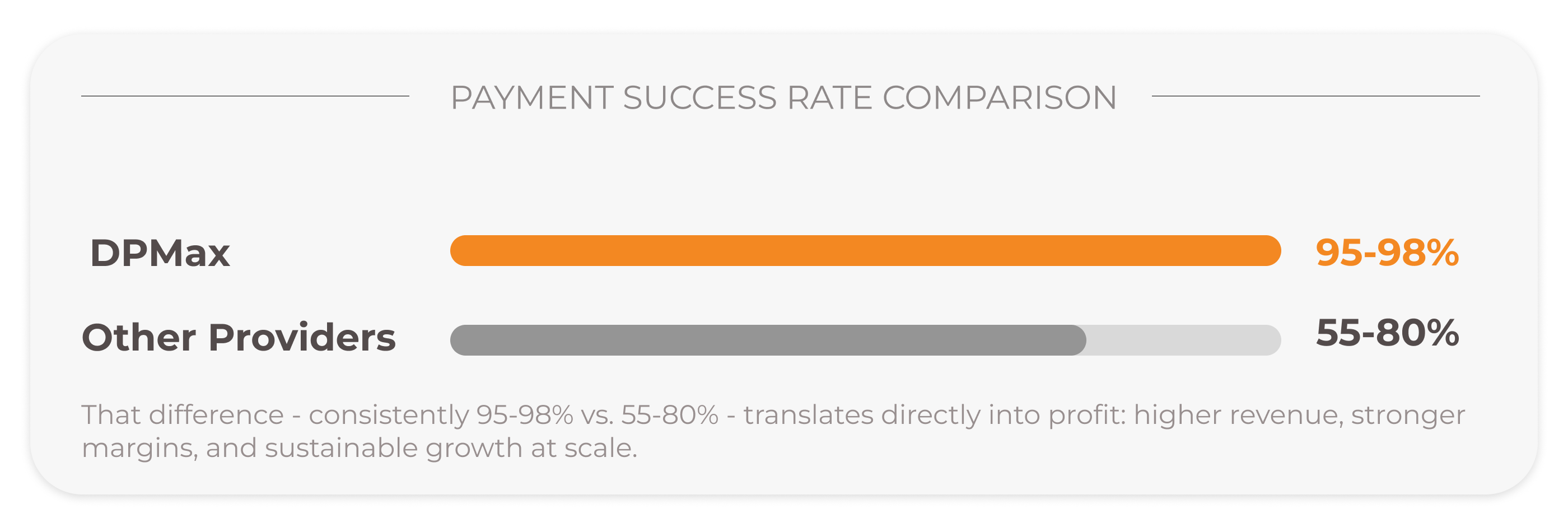
The clearest measure of a routing platform's quality is payment success rate - the percentage of initiated transactions that actually complete. The difference between DPMax and other open banking providers on this metric is not marginal. It is transformational.
Payment success rate comparison
DPMax also delivers up to 10× higher conversion versus legacy providers, multi-currency support enabling true cross-border business, and centralized reporting and reconciliation that gives merchants actionable insights into their full payment data picture. The platform powers some of the world's leading websites by both traffic and revenue.
Europe-wide coverage: the routing engine needs the map
Smart routing is only as good as the coverage behind it. A routing engine with access to three bank connections can optimize within a narrow set of paths. An orchestration platform with the widest European bank coverage available - including all major non-EUR markets - can route across an entirely different order of magnitude of options.
DPMax supports the full range of European currencies, covering both EUR and non-EUR markets:
EUR, GBP, SEK, DKK, NOK, CHF, PLN, HUF, CZK
For merchants operating across multiple European markets, this matters enormously. Rather than maintaining separate provider relationships for each market - each with its own integration, support relationship, DPMax provides a single orchestration layer that handles the complexity across all of them.
Flexible integration: meeting merchants where they are
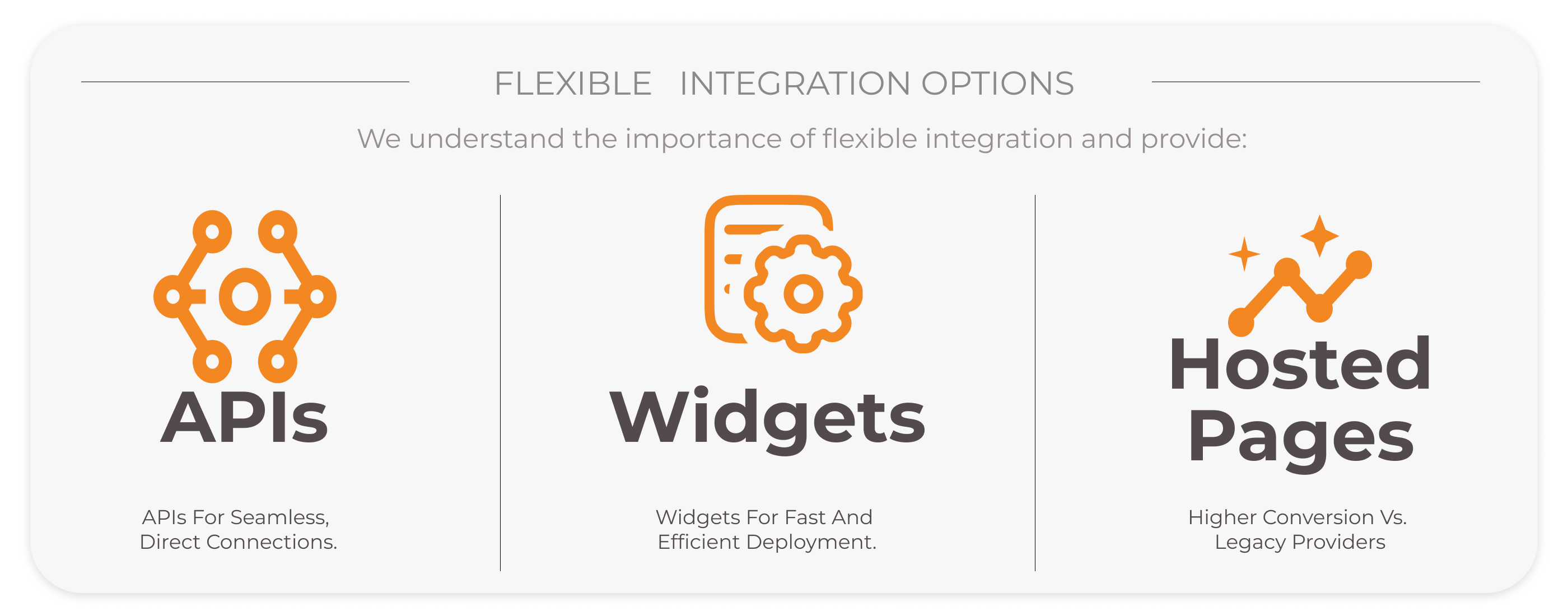
A routing platform with enterprise-grade capability needs to be accessible to merchants at every stage of technical maturity. 2000Charge provides three integration paths, so merchants can go live quickly and evolve their implementation over time:
Security, compliance, and 25+ years of trust
Smart routing at scale is only credible if it is built on a foundation of security and regulatory compliance. DPMax combines over a quarter century of payments experience with a modern compliance architecture designed for the European regulatory environment.
✓ PSD2 and GDPR compliant - fully aligned with European financial regulation and data privacy requirements.
✓ No customer data stored - all payment approvals happen securely at the customer's own bank. DPMax never holds sensitive financial data.
✓ Proprietary in-house technology stack - complete control over performance and security, with no reliance on third-party infrastructure for core routing logic.
✓ Global presence - offices in Europe, USA, and Asia, supporting merchants at international scale.
✓ Independent, merchant-first since 1999, with a philosophy built around merchant outcomes, not platform growth metrics.
The proprietary technology stack is particularly significant from a routing perspective. Because DPMax controls its full infrastructure in-house, it can iterate on routing logic, update bank integrations, and respond to connection degradation faster than any platform dependent on third-party components.
The bottom line: routing is the product
Open banking infrastructure has matured past the point where connectivity alone is a differentiator. Every provider has access to some bank connections. The differentiation lives in the orchestration layer above: the intelligence that decides which path to use, when to use it, and how to ensure it never fails the merchant.
DPMax's 95-98% payment success rates - versus the 55–80% that merchants accept as normal from other providers - are the direct result of building smart AI routing, redundancy, and Europe-wide coverage as architectural first principles rather than add-on features.
DPMax doesn't just process payments. It turns every transaction into profit, maximizes revenue, and delivers the seamless payment experiences that keep customers coming back. For merchants serious about open banking as a growth channel, that's the only standard worth accepting.
Learn more at 2000charge.com
Ready to increase your revenue with local payment methods?
There are a lot more payment methods customers from all over the world feel more comfortable to use and trust much more than credit cards.


