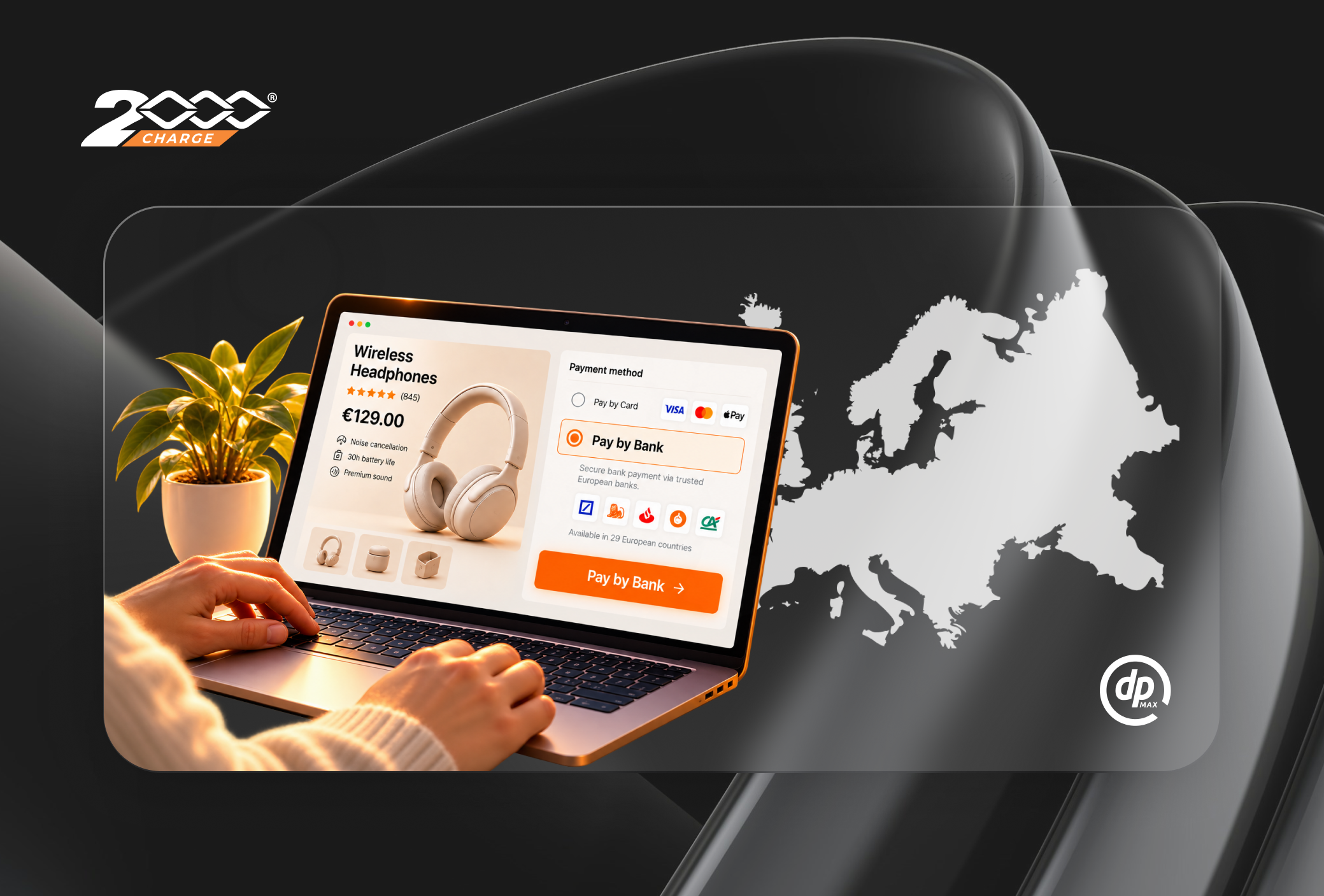
Why One Open Banking Provider May Not Be Enough for European Coverage

Heading

The Challenge of European Open Banking Coverage
Many Open Banking providers operate across specific banks, countries, or regions.
For a merchant, that can create gaps.
A customer selects Pay by Bank only to discover their bank isn't supported. A connection becomes temporarily unavailable. Performance differs between markets. Expansion into another country requires another provider or integration.
As the number of markets grows, so can the complexity.
Merchants may eventually find themselves managing a patchwork of providers, integrations, reporting systems, and payment flows.
That is exactly the type of problem payment orchestration is designed to address.
From Open Banking Provider to Open Banking Orchestration
An Open Banking provider gives a merchant access to bank-based payments.
An orchestration platform adds another layer: the ability to bring different banks, regions, countries, and providers together within a single infrastructure.
DPMax was built around this model.
Rather than relying on one connection to solve every European payment scenario, DPMax combines broad European bank coverage with smart routing and built-in redundancy.
The result is a more centralized approach to managing Open Banking across Europe.
Why Routing Matters
Not every transaction follows the same path.
The customer's country, bank, currency, available provider connections, and other factors can affect how a payment should be processed.
Routing helps determine which available path should be used for a transaction.
DPMax manages transactions by optimizing routes across banks, providers, and countries, helping determine an efficient path for each transaction.
Instead of treating every Pay by Bank transaction identically, the infrastructure can respond to the circumstances surrounding the payment.
Why Redundancy Matters
Coverage is only one part of the equation.
Reliability matters too.
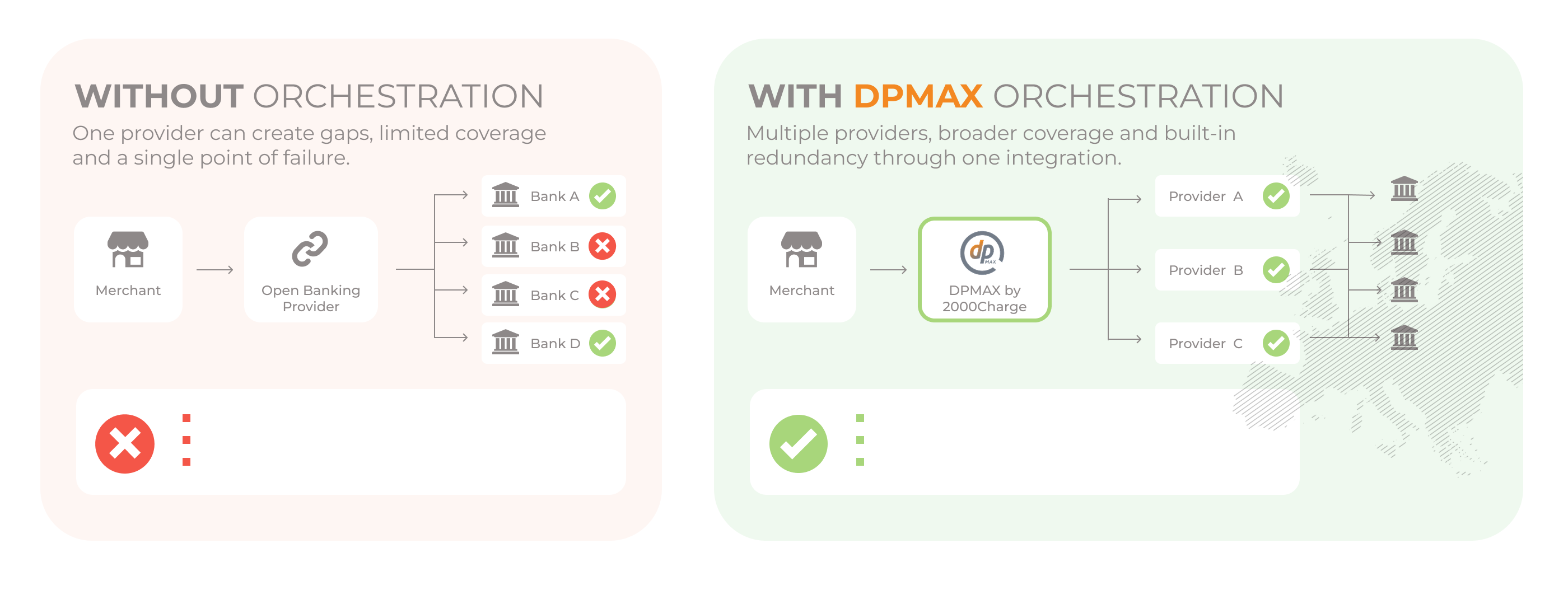
Consider what happens when a merchant depends entirely on one Open Banking connection and that connection becomes unavailable.
Without an alternative route, payments may fail even though the customer and their bank are otherwise capable of completing the transaction.
Redundancy helps address this risk.
DPMax is designed with built-in redundancy so that merchants are not dependent on a single provider connection.
This becomes increasingly important as payment infrastructure expands across more countries and banks.
One Integration Instead of a Patchwork
Without orchestration, European expansion can mean continually adding connections.
One provider covers one group of banks. Another provides stronger coverage somewhere else. Another integration is needed for a new market.
Eventually, the merchant isn't simply managing payments. It is managing payment infrastructure.
An orchestration model provides a different approach.
DPMax brings multiple Open Banking connections together through one platform while supporting flexible integration through APIs, widgets, or hosted pages.
For merchants, that can mean less infrastructure to manage as their European business grows.
Coverage Should Include the Customer's Bank
The customer does not care how many provider relationships sit behind a checkout.
They care about something much simpler:
Can I use my bank?
When the answer is no, the merchant has introduced friction at one of the most important points in the customer journey.
A stronger Open Banking strategy therefore isn't only about adding Pay by Bank to checkout.
It is about making Pay by Bank available to as many relevant customers as possible - and having the infrastructure behind it to keep payments moving when individual connections encounter problems.
Think Beyond the Provider
Choosing an Open Banking strategy shouldn't only involve asking:
Which provider should we integrate?
Merchants should also ask:
What happens when that provider cannot complete the payment?
For businesses selling across Europe, coverage, routing, redundancy, reporting, and integration flexibility all become part of the equation.
That is the difference between simply connecting to Open Banking and orchestrating it.
One Connection. Broader European Reach.
DPMax by 2000Charge brings Open Banking providers, banks, regions, and countries together through one integration, supported by smart routing and built-in redundancy.
Discover how DPMax can simplify your European Pay by Bank strategy.

Keep Exploring

The Hidden Revenue Leak in European SaaS Payments
The Hidden Revenue Leak in European SaaS Payments

Is Your European Checkout Ready for Black Friday 2026?
Is Your European Checkout Ready for Black Friday 2026?
What PSD3 Could Mean for Your Payment Strategy (Even If You’re Not in Europe)
What PSD3 Could Mean for Your Payment Strategy (Even If You’re Not in Europe)
Ready to increase your revenue with local payment methods?
There are a lot more payment methods customers from all over the world feel more comfortable to use and trust much more than credit cards.